Showing posts with label Pigs. Show all posts

Sunday, September 15, 2013

Estimating Corn Yield

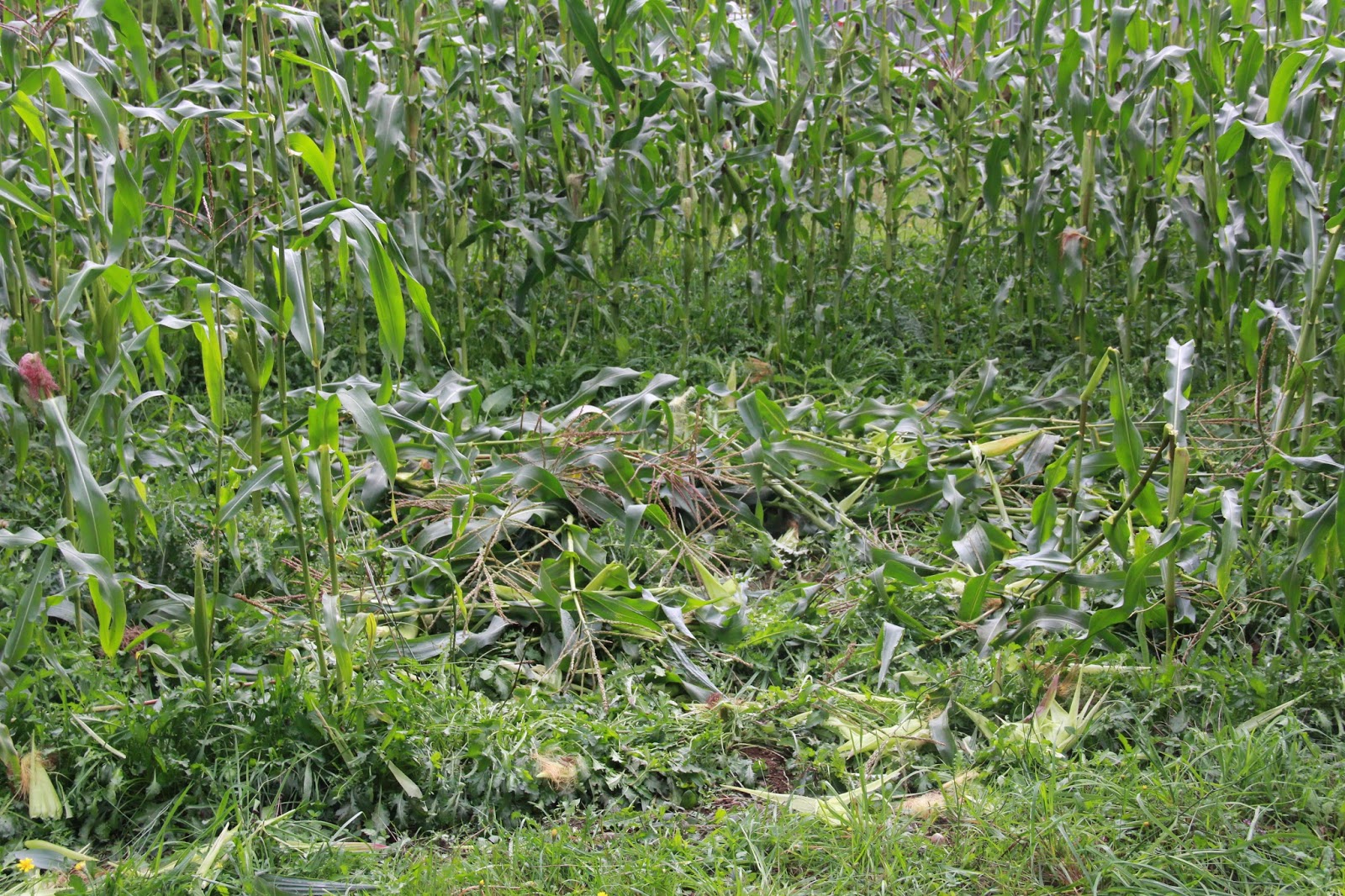
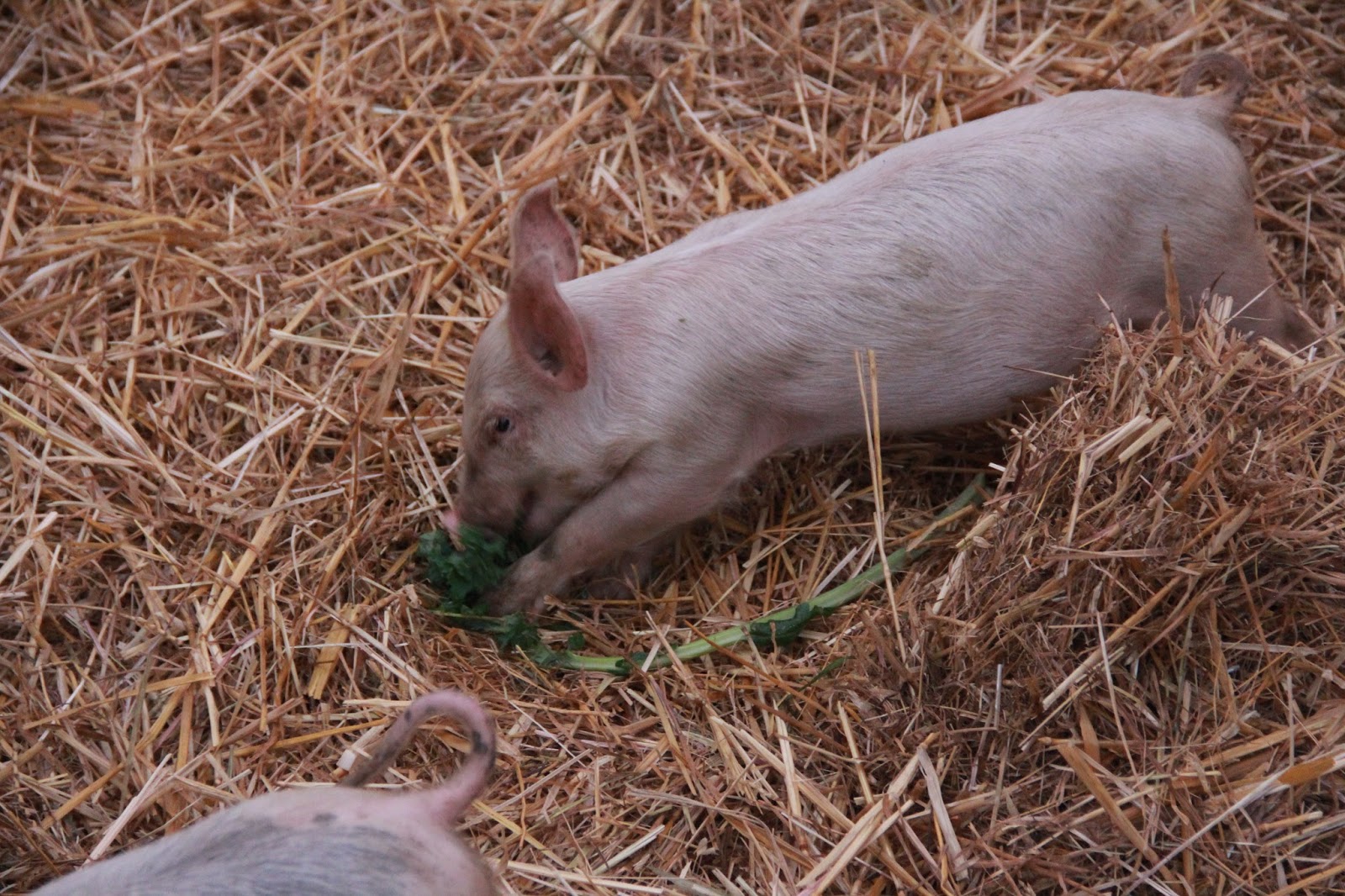
I've been feeding the pigs a little bit of ear corn. They attack it with great vigor! I thought it would be fun to estimate yield from our little plot. The national yield this year is predicted to be 155.3 bushels per acre. This, of course, is heavily managed hybrid corn. Gene Logsdon got 110 bushels per acre from the Open Pollinated variety "Reids Yellow Dent." I grew Nothstine Dent as I outlined in this blog entry. I picked and shucked corn from a 125 square foot area, it filled a five gallon bucket.
The sacrificed area
5 gallon of ear corn
The best looking ear of the group
A couple were pretty...
The worse


A couple weren't...
Dent corn


Some were drier than others...


Now for the math to figure out bushels per acre. A bushel of shelled corn, corn that is no longer on the cob, weighs about 56 pounds. To get a bushel of shell corn from ear corn, what I have, you need 70 pounds of ear corn. That five gallon bucket weighed 23 pounds.

23 pounds of ear corn equals .328 bushels of shell corn.

.328 bushels per 125 square feet. 125 square feet is .00287 acres.

.328 bushels per .00287 acres.

Time for some algebra:

.328 bushels/.00287 acres = x bushels/1 acre

114 bushels / acre

Pretty respectable for open pollinated if this method of estimating is at all reliable. I imagine I am not acounting for lots of variables. How accurately did I measure the sample area? Not very... How does the moisture content of the corn play into this? I don't know...

Regardless, The numbers suggest this was worth doing. This means I will get about 11.5 bushels of corn. The price of corn today is 4.59 a bushel. Sweet! I raised $53 dollars worth of corn. Of course I spent about twice that on fuel, manure, seed and urea...

These folks a couple hours south me got 60 bushels / acre with Nothstine.

Now this is better corn than from the feed mill. Open pollinated is supposed to be higher in protein than hybrid corn. It is definitely non-GMO. The pigs enjoy it fresh. The nutrients and organic matter from the manure will benefit the soil for many growing season beyond this one. Since it is open pollinated I can reuse seed and I only used a small amount of the urea which I can save for future years. So we will call it a wash... Just like what they found in the movie King Corn! I need to sign up for my subsidy ;)

Maybe I will try this corn yield estimate on a different part of the field on a future date this fall.

On a different note I found this pile of poop near the corn. We have had a black bear sighting near our house recently. Is that what this is?

Bear scat?


Sunday, September 8, 2013

Deep Litter Bedding, Week two update

 The pigs have been eating well and leaving lots of waste. The daily chore is to go out and pull the litter away from the electric fence wire and ruffle up the beading as to cover up any poop on the surface. Read about the back ground of trying this bedding system here. This has been working well to cover up the poop smell but I have noticed a growing ammonia smell.

 I decided to dig the manure fork in further and really churn things up. That only made the ammonia smell stronger. Time to hit the Google search engines and see what I could learn. Lots of academic research to read on the subject. Chose not read that, too much like the day job... I found the chicken raising message boards the most encouraging. Ammonia smell is bad. Earthy smell is good. If you smell ammonia you need to add more carbon. I added two bales of straw and fluffed it up really well. We'll see if that helps with the ammonia smell, it sure did initially!

This method of deep litter bedding is more similar to chicken type systems I have read about, adding litter so you end up with a deep litter  The pig systems I have read about seem to focus on starting with a lot of carbon and keeping it fluffed up. I wish I could smell things over the internet to see what these other barns smell like! This blog entry for example!

This is a good clean out story and how he prepares his barn for the next round.

After churning up

Straw touching hot-wire


Churned up, but moist and stinky

New straw on top


Monday, September 2, 2013

Pigs eating corn

Threw the pigs some corn today. They love the fresh green stuff!


Feed Efficiency

The last time we raised pigs in the winter of 2011-2012 we used 12,400 pounds of feed for 13 pigs. That's approximately 950 pound per pig to go from wean to market. It also took them 6 months to go from wean to market. This seems very inneficient! Storey's Guide to Raising Pigs (page 50) by Kelly Klober says that it takes between 650 to 750 pounds to take a pig from 40 pounds to market. Small-scale Pig Raising (page 4) by Dirk van Loon assumes 700 pounds of feed to take a pig from wean to 220 pounds. My pigs dressed out to 180 pounds which means, according to this website, that they had a live weight of approximately 250 pounds. 30 more pounds of gain would take about 100 pounds of feed. Regardless I used 100 to 200 pounds more feed that I should have needed to. Now assuming today's price of .26 per pound for feed, $26 to $54 per pig wasted times 13 pigs equals $338 to $702 wasted. Yikes! Obviously I missed the mark by a long shot so this go around I am making some changes.

So what factors lead to this inefficiency?

1. Home made feeder was letting to much feed out.

2. Pigs were standing in mud while eating so any food that hit the ground was unrecoverable

3. Feeder was not well protected from the elements so excessive food in the trough of the feeder got wet and became unpalatable.

4. Not enough bedding when raising pigs in winter so they shivered off many calories.

Wasteful feeder


In this picture you can see a couple of bad things. First, the pigs standing in the feeder to more easily reach the feed. Sometime after this picture I did put a 6"x6" landscape timber I had sitting around in front of the feeder for them to stand on. Muddy trotters in the feed trough doesn't help the feed stay fresh. Notice all the feed on the ground... and this is when it was still relatively dry out. By this point the pigs have ripped the lids off the feed trough. What a mess.

Homemade pig feeder when new
As you can see in this picture the trough had lids at one point, but the pigs were too rough with them and they ended up getting ripped off. Also note the the giant gap between bottom of the trough and bottom of the storage hopper. This let way too much feed out.

The whole picture
The flip top roof was good for filling but did not provide nearly as much protection as you might think it would!

For this round of pigs I have built a deck for them to stand so they can reach in the feeder easier and be out of the muck. The feeder is now also in the hoop house so the only moisture that can get in the trough is from the pigs bringing their wet snouts from the waterers or from condensation from the tarp that covers the hoop house.

Feeder after modifications
So here it is after modifications. I added a 2 by 6 across the bottom so now the opening is only 1 1/2 inches from the floor of the trough. With it also being 1 1/2" thick it really reduced the feed output. So much so I felt compelled to break out the sawzall and cut out some areas for increased feed to get out. A google search for adjusting pig feeders revealed these reference cards. I wish I had know to search for these earlier! I think my feeder still flows a little too freely. I will keep an eye on it and report back over the coming months. I already see some feed on the decking I built and there is some moisture from the nipple waters, but nothing like it used to be. Time will tell though as the pigs are still small!

One of the advantages of the hoop house is all the bedding involved and the heat from the composting action that should be happening by this winter. By keeping them out of the muck, and this extra warmth I hope to observe an increase in feed efficiency. Here is some research to support my "shivering off the calories" premise.  I discussed the hoop house and straw bedding at length in this blog post.

In addition to these measures I am hoping that the corn we are growing will help offset feed costs as well. It will make it harder to measure feed efficiency but will help reduce the amount of purchased feed to reach market weight.

Now for cute pig pictures...


Rooting below the straw in the deep litter bedding.


Friday, August 30, 2013

Pigs eating a pumpkin

This is from two years ago when I saved some pumpkins. At 6:45 they get a good zap from the electric fence.

Thursday, August 29, 2013

Corn

A load of Manure
 I have a flat area on my property that is about a 1/10th of an acre that I have always envisioned as a corn field to raise corn to help supplement feed. Last year I tried but failed miserably. I planted it too late and didn't add any nutrients to the soil. Did I mention it failed miserably?

Piles of Poop
So last spring I brought in 8 yards of cow manure from my local landscape supply. The trailer can handle 4 yards, so it took two loads. The landscape supply is not two far away so it was much more economical to do it this way than to have them deliver in one big load.

I unloaded it with the Yanmar's loader, dropped it off in these piles, spread it out with the front blade on the Farmall Cub, and then tilled it in with the 4' rototiller I have for my Yanmar. A great day of hobby farming!

Baby Corn
That was in April. In mid-May we had a warm spell and I planted the corn with my earthway seeder.

When the plants were having just germinated I ran my 1970's horse rototiller down the rows. I did that one more time while the plants were small. and left them for quite a while. When they were hip high I side dressed with Urea (40-0-0) at the rate of 1 pound per 100 feet of row. I tilled it in with the cultivator attachment I have for my Stihl Kombi-System and irrigated.

I used the kombi-system because it is much more narrow. I have read that at certain heights you have to be careful of how close you cultivate to the roots as not to cut the ones near the top that keep the corn from lodging (falling over). I recently bought a cultivator for the Farmall Cub that I found on craigslist that I look forward to experimenting with next year.
I only irrigated two or three times. Several neighbors were quite concerned with how little I was watering.

The corn is an old open pollinated variety called Nothstine Dent that is supposed to be well suited to our short growing season, drought tolerant and is know for its use as feed and corn meal. I plan on saving seed.
Weeds in corn

Well... We did get weeds but they are only in the rows. From this angle they look out of control. When you look down the row, it doesn't look so bad.

Weeds like my hair in 1992

But when you pull the weeds back you see that they are a mop top and it is bare soil beneath them. I wonder if the mulching qualities it brings out-weighs the nutrients the weeds steel from the corn? The plan is to feed this is as ear corn to the pigs and use the stalks as bedding. My son and I fed them several ears yesterday and they really went after them. It will be interesting when it is all said and done to see how much this helps the feed bill. Of course there is the cost of growing it... 8 yards of manure, 1.5 pounds of corn seed, fossil fuels, Urea...Experience of growing it, priceless.

Wednesday, August 28, 2013

Evolution of the Hoop House / Deep Litter Bedding

Well these first couple of posts are turning into postmortems on my first couple of cycles of raising feeder pigs in the winter. The initial idea was pigs in the winter, they poop and then garden in the summer. Though working well in theory, in practice it was a muddy mess and the pen took too long to dry in the spring to get in there with the tiller. A big problem with our already short growing season.
Pigs in Mud

They did have a place to get out of the mud, but it was still kind of cold with no good place to bed down really well. Shivering away the calories (future post on feed efficiency) was not good. The neighbors complained to the health department (another future entry topic that has a happy ending). I needed a better way.

I first learned of the concept of deep litter bedding when reading a book on raising chickens. A few google searches lead to this article, this blog entry, and this blog entry. So I decided I would try to make my own variation on the hoop house. I used cattle panels, t-posts, a tarp, ratchet straps, lots of zip ties. I can give more detailed instructions in a later post, if people want them. At that time I also built a deck on skids to put the feeder and water barrels on.
Hoop house skeleton

Using small pieces of hog panel and electric fence I combined this with my old hog house I had built on skids and got to this:

Inside view from feeder with straw

I put rebar in the ground and ran a hot wire along the inner perimeter so the pigs would leave the hoop house alone and it has been working great, so far.

The idea is that the pigs will eliminate waste on to the straw. The straw will soak it up, bond the carbon and nitrogen thus minimizing smell and providing warmth from the composting action. All I have to do is keep adding straw to wet spots and the bedding pack will build up. Toward the end of the pigs time hear I do plan on letting them out in the garden space to do some tilling and gleaning but not let them turn it into a moonscape like previous years.

Just south of us is a farming community that has some small wheat farms and I was able to load up on 50 pound bales of straw for $2.50 a bale. I got 60 bales, I should be set. Craigslist once again!

Kids and Straw
So I'm set to go, right? Well right away a problem showed itself. The pigs were choosing to defecate in the old pig house that has a wood floor and not on the straw! It stunk! I shoveled poop two days in a row to put it on the straw. This was not the plan!

So I went to work to barricade them out of the pig house until they were trained to do their business on the straw. Scrap wood pile to the rescue.

It's ugly, but it has worked! The pigs are doing all their business on the straw now. Now to keep an eye on the moisture level and add straw as necessary.

One other little problem that has come up is that the straw keeps building up around the edges and hitting electric fence. Not a huge problem but I have go in everyday and kick it away from the electric fence wire.

So hopefully with this setup I will keep the pigs dryer and warmer, minimize mud, and have some great compost in the end. I will keep you updated.

Monday, August 26, 2013

Too much kale!

We planted kale for the first time this year. We planted one 40' row. The kale was happy, very happy.
Kale after eating on it all summer and giving some to just about anybody who comes over.
I thought about sending some off to our local foodbank but decided instead to save it for the pigs. They like it, a lot. Happy kale, happy pigs! Eventually we will let them loose in the garden area and that kale won't last long.


Sunday, August 25, 2013

The first post!


I made this blog a year ago, or so, and promptly wrote nothing...


The idea is to write about my hobby, farming. I do have a day job that covers 99.9% of my income and farming covers the other .1%. Definitely a hobby. I like the gear, I like the animals, but mostly I enjoy eating good food and hearing how much people enjoy the food I raise.

So what do I raise? Among my friends and family we are mostly known for our pork. Once a year we raise a set of weaner pigs to raise to market weight and sell to friends and family. We keep half of one for ourselves. We get pigs in 10-12 pigs in August and keep them until January or February.  This schedule works well with my professional life as I am out of town often in the summer, but rarely leave town starting in September. We are in Western Washington State.

Let me give you a quick tour of our ranchette. Each picture will prompt a further blog entry!

The House (when getting a new roof earlier this summer)
The house, getting a new roof.

Late 70's ranch style. Been here 5 years and slowly updating.

The corn "field". 1/10th of an acre of Nothstine Dent. I am growing this to feed the pigs and see if it will supplement feed costs at all.


If it doesn't, it has been a good experience growing it!


The long view


Compared to a 6' ladder. This is from August 10.


Next up: The fleet

Tahoe and Trailer. The Tahoe is our substitute for a farm truck. It does a good job pulling this 16' trailer and whenever we need to haul the whole family and lots of gear. It used to be a daily driver, but now is hanging around for its specific tasks.


I built these removable sides for the trailer. Great for bulk materials or young pigs.
Trailer with sides, when new


The tractors:

The fleet


The Yanmar 2210d was bought used, years ago for brush hogging and general utility, The Farmall cub has been in my family since it was new in 1950. The lawnmower cuts grass... Also in this picture you see the grain bin and hoop house. More blogs in the future about all of the above. Lots of other little pieces of gear.

The pigs:

Picked up the latest batch of pigs today, which prompted a blog entry. Pick up from a local farmer who is super small scale as well, but WAY bigger than me.
New pigs in hoop house
The hoop house is new and look forward to see how I can make it work with my variation on deep litter bedding.

The pigs live in a fenced garden area. Great fertilizer!

Garden from early June


That's all for now. More details in the future with stories on how we have done this in the past and how we got where we are! I have lots of pictures saved up!